Showing posts with label Close Reading. Show all posts

Can competition lead to increased comprehension?

01 September 2016 / 1 comment

Can competition lead to increased comprehension? This seems like a bad combo. We've nearly eliminated competitiveness in some schools -- sometimes to ridiculous extremes. However, we usually try to avoid it in class. We don't want one student to be the best at something -- all students can succeed. So, why would I have this idea and what successes have I experienced that prompted me to explore this idea?


80's Childhood and Reading Machines

I have to briefly go back to my childhood in the 80s first. I was a voracious reader as soon as I started reading. I was one of those kids who had a book for every car trip and tried to read in the dark (you know, wait for each street light so you can read a few more words). My school had a reading tool that they used. I have searched for the actual item on the internet and haven't found it. If you know what it is, please let me know! We called it a reading machine. You had a reading passage that you would feed into the top of the machine. It would roll around a large cylinder and only show you a line at a time. It would continuously advance based upon the reading rate for which it was set. Once you finished "reading" the passage you would take a comprehension quiz. If you passed the quiz (I can't remember if you needed 100% or some other passing grade) you would advance on to the next speed. Now, I am not recommending this method and haven't thought about it in a while. I wouldn't say I was reading for enjoyment at all, but I did learn to skim passages quickly which is a great skills for more advanced courses. I loved it. I loved challenging myself to advance to the next level. It was like a game. A game for good readers. I'll share a few tips below for individual competitions.

Scholastic News for Close Reading

Fast forward to last year in my 3rd grade classroom. We use Scholastic News and last year we really enjoyed all the benefits of using the additional resources in the electronic version. The students loved voting on issues and seeing if their results matched the results of kids around the world. The other thing that was a huge hit were the quizzes. I didn't start out doing them all the time and then the kids kept asking for them. I was completely sold on this version of quizzing when I saw some close reading taking place. The game board has different point rewards for each category. The least complex questions would gain the fewest points, etc. I would divide the class into teams. The team (either a team representative or someone I chose) would choose the category. I would display the question and the team would decide on an answer. If they didn't immediately know the answer, the whole group would grab their Scholastic News and start searching and reading everything again carefully! That's what we are always hoping they will do!

Valuable Competition

I think some competition can be valuable. You can compete against others or top your own records.

For individual competition, my students enjoy a reading board that has bead chain necklaces. They get a bead for each 100 minutes that they read. They get a special bead or charm for each 500 minutes that they read. Some of my students have been very motivated to read as they see others start to fill their necklace.

Team competitions can be a quiz like the ones I mentioned or a variety of learning games. Make sure the teams are fair and change players at times. Be mindful of any team winning all the time. Then you would want to switch things up and make it more equitable.

In my classroom, adding the element of competition has also shown increased engagement, an opportunity to practice teamwork, purposeful answers (to make sure they get the points) and reading things more carefully.
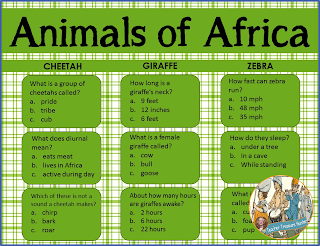
Animals of Africa powerpoint

Powerpoint Classroom Quiz

1. Create a quiz using this powerpoint template (or use the included African Animals quiz and research pages). Just click on the picture above to download this quiz and 3 African animal research papers. Click here to get a powerpoint with the blank game board. Just add your own text boxes.  

2. Everyone reads the passage silently (chapter, multiple passages, etc.). Tell them there will be a game with questions from the passage so they need to read carefully.

3. Divide the class into teams (2-4 teams). Choose a team to start.

4. Show the board. The 1st team chooses a category and point value. They can look back to find the answer. Designate someone as an official team spokesperson (someone who will listen to others).  Ask, is that your final answer to make sure the team agrees. If they miss it, you can tell the answer and/or show where it is in the passage. The team only gets points for the correct answer. 

5. The team with the most points wins!

Have a great week!


Read More...

Keeping the Reader Engaged

22 February 2016 / Leave a Comment


My second graders are becoming such great readers at this point in the year.  However, it is always challenging to keep them engaged in the text and to be responsible for their reading.  I believe that students will be more engaged when they choose books for themselves.  One method I use is to have each student keep their own book box for independent reading.  In that book box  my students keep a reading log and track the genres of the books they are reading.  I use a very simple reading log sheet and a reading genre wheel.  The Reading Genre Wheel is a freebie from Rachael Parlett.  It is a great addition to your book box materials!! 


One of the most valuable tools I use are my Reading Buddies Talk Bubbles!  My students pair up with their reading buddy to read the anchor text each week as well as other selections they have chosen throughout the week.  Before reading they determine the genre of the selection and then choose a talk bubble from the appropriate tub.  After reading the selection the buddies discuss their question and then choose a writing response bubble.  I have found that these bubbles really aide in the comprehension of the story or informational text.
 
 
 I hope these ideas will be useful for your classroom reading instruction.  Please check out our
 CTR Reading Board on Pinterest for more great ideas!!


Read More...

Fall Science Centers

24 October 2015 / Leave a Comment


Hi Friends,
It is Sarah from Science is for Kids. I have some great fall centers for you.

Fall is one of my favorite seasons. We have been on a fall scavenger hunt looking for leaves, acorns and other signs of fall. We are lucky to have an abundance of Oak Trees on our campus. One of the things the children look for is acorn that a squirrel has eaten. There are a lot of those wonderful little hulls under the trees. Looking for these acorns and finding them is a concrete way to put part of a food chain together.

On a recent trip to Michael's Craft Store I saw a couple of things that would make great science centers for fall. I am sharing two with you today.. This first one is pictured above. I got some witches fingers and plastic eyeballs. The children are learning about force and motion. I am also working on Newton's Laws of Motion. The children use the fingers to pick up an eyeball and drop it into a graduated cylinder. You can use any container that you have on hand. They are demonstrating that an object stays at rest until a force acts upon it. I also placed some pom, poms in the container as well. The children pick up the objects from the table. This is great fine motor practice as well.


I saw these Styrofoam gourds too. They were on sale so I couldn't resist them. This center teaches about balance. I used plastic spoons I had on hand. The children get a spoon and a gourd and balance it. I gave them an area of the classroom to walk around in so they would not just wander about. Some of them got fancy and put three spoons in one hand and balanced three gourds. This is a fun way to practiced balance and it strengthens focus as well as coordination. Win! Win!

I also have two products in my TPT Store for fall that you can use in your classroom. Please check out my close read for pumpkins. This is a Non-Fiction passage. I have included several art activities as well,.

close reading pumpkins

I have a speaking and listening product that I love. Speaking and Listening Jokes and Riddles for Fall. We love jokes and riddles. This product also has an art activity in it. Check it out.


Enjoy Fall,
Sarah Tharpe Winchell
Science is for Kids
Read More...

Reaching a Potpourri of Upper Elementary to Middle School Readers and a FREEBIE

06 April 2015 / Leave a Comment
Hi there!  I am Erin Beers from Mrs. Beers' Language Arts Class.


http://mrsbeerslanguageartsclass.blogspot.com/

I am a 6th language arts teacher in Cincinnati, Ohio.  I am so thrilled to be a part of the Classroom Tested Resources crew.  I love to collaborate and share with others who are just as excited about working with students at the upper elementary to middle school level.

Our focus this month is on the letter P!  When I think of that letter in my classroom, as an upper elementary to middle school teacher, I have quite a POTPOURRI of readers in my classroom, but the most common tend to be the ones that are not excited about reading.  SIGH!  I am always in search of high-interest resources to share with these uninspired not-always-enthusiastic-readers because not only do they struggle with comprehension, but fluency!  Can you relate?

Over the last ten years, I have incorporated a modified, high-interest version of 6-Minute Solutions into my reading instruction. I fell in love with the idea from a professional development opportunity that focused on enhancing fluency and comprehension with older readers. 

A quick run-down of 6-Minute Solutions:
  1. Students are partnered with a similar level reader.
  2. Each student is given a reading passage on Monday that is numbered to gauge the number of words read.
  3. Students exchange passages.
  4. The stronger reader reads aloud while the second reader follows along marking any miscue that is made.
  5. Teacher times for 1 minute.
  6. At the end of the minute, reader 2 tallies the number of words read in the minute, subtracts the total of miscues, and records the number of words correct per minute.
  7. Reader number 2 then reads and the process is repeated with this second reader.
  8. The passage is read Monday-Friday with the "Fluency Partner" and then the last, or 6th read, is done with the teacher on Friday, hence 6-Minute Solutions.  The student then completes the questions that accompany the passage for comprehension.
  9. The students can see their fluency growth with the passage from Monday to Friday, which they get especially proud to see.  While I want them all at that 150 wcpm with grade-level text, the progress made getting to that point is what I find to be most essential.
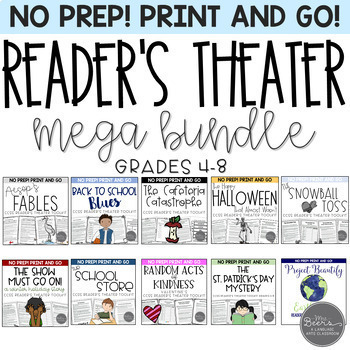
While 6-Minute Solutions is a great start, I wanted MORE read-aloud and close reading resources.  So I began utilizing reader's theaters as another tool to enhance fluency with my crew, and close reading.  I soon realized that my students were O-B-S-E-S-S-E-D with performing reader's theater scripts.  For whatever reason, they LOVE to take on special characters and truly get into the script, but scripts for upper elementary to middle school can be really hard to come by.  So I started writing so my students had high-interest resources to engage them...

I have created bunches of reader's theater toolkits as a way to enhance fluency, context clue word work, comprehension, and writing.   They are all high-interest scripts that will engage your students so well that they will forget they are working hard as effective readers.  While these toolkits are the perfect resource to utilize any day of the week, they are the perfect resource to keep your students engaged with substitute teachers.  Here is one that every student in your class will LOVE that is perfect for this season! 


https://www.teacherspayteachers.com/Product/Earth-Day-Readers-Theater-and-Informational-Text-Toolkit-for-Grades-4-8-1166642

I utilize reader's theater in this way...


  •  I copy the passage and extension activities for students. 
  • I give students 2-5 minutes to preview the passage and determine which character they might like to perform
  • Based on class size, I may be able to have multiple groups perform the same play.
  • I display characters/parts in the classroom for students to see.
  • I pull Popsicle sticks with student names to make character selection most fair.  As I pull a student’s name, they get to pick which part they would like
  •  I then write the student’s name next to the character/part as a reminder.
  • Once all parts have been selected, I give students another 2-5 minutes to scan through to locate their part.
  • Finally, we begin the passage.  I will have my students read aloud as many times as I find suitable for them. 
  • Answer Reader Response Questions, complete Context Clue Word Work, complete Journal Prompts and other extension activities.

Finally, here is a FREEBIE to help your students learn more about Earth Day while using their close reading strategies to improve comprehension.  In this FREEBIE, I have included how I teach close reading to my upper elementary readers. Enjoy...


I hope you found some ideas to benefit your older readers.  Feel free to share any engaging ideas or resources you utilize because I LOVE to hear about what you do that works with your kiddos.  I will check back soon!
post signature
Read More...
Powered by Blogger.
Back to Top