Showing posts with label Fluency. Show all posts

One Teaching Technique EVERY Teacher Needs

05 November 2015 / Leave a Comment
Are your kids fluent readers? If the answer is some, then this post is for you. Creating poetry notebooks for repeated reading is a great strategy for improving fluency. Check out this post for more

When you think about your classroom routines and your teaching methods, what three techniques are your go-to options? Maybe it's interactive notebooks, anchor charts, and Daily Five?  or Maybe you love Close Reading, Mentor Texts, and Centers? I'd like to propose that you poetry notebooks into your daily routine.

Read More...

STRATEGIES for High Frequency Words

26 June 2015 / Leave a Comment

Hi There!  It's...


How do you guys practice word work in the classroom?  Do your kids go from week to week forgetting the words from the previous week?  Do they say they are practicing at home, but you can tell that they haven't even looked at their words since you introduced them?  Well, these were some of the issues we were having until we decided to incorporate our words throughout our day for an entire week.  I KNOW - yes, I should have known to do that, but we have honestly never been trained on how to get children to LEARN high frequency words.  We went over the words, practiced the words with flashcards throughout the day, BUT that wasn't enough.  My strong kiddos were fine, but my struggling students had a really hard time keeping these words in their heads.

So, two years ago, my first grade team decided to make our own curriculum with words that we felt students needed to know.  We used both Fry and Dolch words, and put together some of the things we felt would help them retain the words.


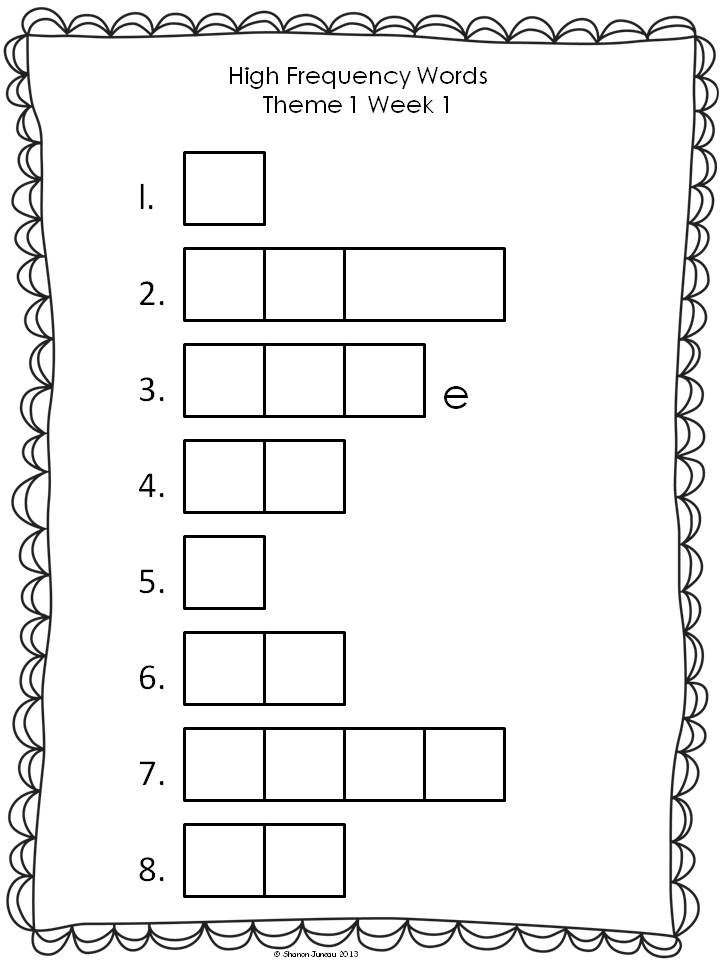
We introduce the words using Elkonin boxes and a baseball game.  The students have their Elkonin box sheet in front of them, and we play Baseball with the words.  The ppt walks you through the game.  The kids chatter, "Hey Batter, Batter..." and then instead of saying SWING, you (the teacher) say the word.  Once you say the word, you ask the students how many sounds they hear.  Then the boxes appear to show how many sounds, and then the word appears per sound.  Once you talk about the word, then the students write their word in the boxes.  I usually have two students say a sentence with the word as they are writing it in their box.  We do this for each word that we have for the week.  

We also have a ppt that we use throughout the day that reviews the words.  Students need to say these words within 3 seconds by the end of the week, so we use our ppt daily for practice.  Sometimes we call each table up to say a word before we can get water, other times it's just a 2-minute filler before we transition to another task.  The powerpoint stays at the bottom of my screen for easy access.


We also have two sheets that we place in the students' binders.  These go home on Monday, and students practice the words and sentences nightly as part of their homework.  Now, some do, and some don't.  We include these sheets so that if a student is having trouble, we can refer to these during conferences. 

Here's one place where students get daily work with our words.   


  • FILL IN THE BLANK: We have pages that have the sentences that students need to practice with the word missing from the sentence.  We have these sheets as fill in the blank with two words to choose from, or fill in the blank where they have a word box to choose from.  We usually start off with most of the class having two words, but gradually move to word boxes.
  • ADD AND SUBTRACT LETTERS:  We have pages where students need to either add letters to make a new word, subtract letters to make a new word, or substitute letters to make a new word.
  • ABC ORDER:  We start off with only words with different first letters, and eventually move to second and third letter order.
  • MIX IT UP:  For our mix it up pages, students have to unscramble the words and then add them up. (The tiles are scrabble tiles, so they add up the points.)  We have another one where they just have to unscramble using the word box.
  • WORD SEARCH:  We also have word searches for the words (a favorite of the kids).  There are different levels of the word search.  I let the kids pick which one they want.
  • CUT AND PASTE:  We have sheets where students have to cut out the words and then glue the words into the boxes to make one of our sentences that match our homework binder work.


Another thing I found useful was making flashcards for students to grab anytime they have down time. We also grabbed these during centers to work with a partner.  One person is the teacher and the other the student.  The teacher has the timer, and the student tries to say the words as fast as they can.  Students actually liked this center.  I guess anytime you give them the role of teacher, they want to play.


We added this one at the beginning of this year, and WOWZA, they loved it!  I used these during guided reading, but students were also able to play BE THE TEACHER with these as well.  The object was to say each sentence correctly, and go through the sentences within a minute.  Not an easy task to do, but once they realized that they had these sentences in their binder as well (and they could practice), they ROCKED it!!  Competition is such a huge motivator.  I had one student who was really struggling with these, and one day during RTI he met his goal!  I overheard this conversation:


Student A: "Guess what I found out?"
Student B: "What"
Student A:  "These are the same sentences that are in my binder."
Student B:  "Really?"
Student A:  "Yep, I'm going to tell Mrs. Juneau so she can tell the class!"

HAHA!!! 

Anyway, these really did help with our fluency (On Dibels as well!)  


OK - so this little center is one of my favorites.  We were told years ago to have students write sentences and then cut them up and then put them back together.  I loved that idea, but truth be told, it's not something I could get to on a daily basis in GR.  This year, they cut our guided reading time, so this center really came in handy.  

This one takes a little bit of prep, but it is so worth it.  I bought white envelopes (the smaller ones) and then taped the sentence sheet on top and laminated.  All the cards go into this envelope.  

  • Buy envelopes to put word cards in (I bought the white ones - small)
  • Tape the sheet with all of the sentences and laminate
  • Students work in pairs (we have two per week and the borders are different so if they get mixed up, students know which envelope the word cards go in)  Meaning, one group works with the curly border and the other group works with the square border.  They race each other.
  • For each group, one student reads the first sentence while the other student builds the sentence with the cut-up words
  • Then they switch roles.
BUT...  it usually becomes pretty competitive since they are racing the other group, so usually they are both building the sentences and both reading the sentences.  It's really cute to see how well they can SYNERGIZE!


I also have included word wall cards that have all the words for the week.  I have a few different colors and either chevron or polka dot background to pick from.  I started off using these this year, but ended up changing my word wall completely.  This worked for me last year, but for some reason I just couldn't get it together this year.  Two of my co-workers did use this system, though, and loved it.


We also have cards in a center that have all of the words for the month.  With these cards, students get the timer and time themselves saying the words.  Students also have a booklet that they keep in their GR bag to track their score in words per minute (this can be done at home)  If you do these at school, you will need a stopwatch.  We didn't actually do these this year, because my students really retained the words, but last year I had a few that needed this extra practice.  


We are a Leader in Me school, so we also needed something for the students to track themselves.  We use our Words to Know Data Graph for this.  On Fridays, I call students up one at a time and they have to say the words within three seconds.  If they miss a word or struggle with a word, I circle it in pencil.  They color all the words not circled.  They know they will have to practice a bit more, and the next week we try again.  We use these graphs for our student-led conferences as well.  The students can explain it beautifully!


All of the above items are included in the weekly product.


Here are some other items that we use in our classroom that I know have helped tremendously with building a foundation of word recognition.  These games still use all the same words, but it's a month of words, rather than weekly words.  So, once you have a month of words under your belt, then you introduce the first set of games.  


My students have created their own version of this game, and since this is our second year doing it, and both classes did exactly the same thing, I'm guessing other classes are doing this as well.  They like to play in groups (usually 2-4 students).  They "divy" up the cards evenly, then turn all the cards face up.  One person starts the game, and then whoever has the next word, says it.  Once you say that card, you turn it over.  If you can get through the entire game, turning over the cards as you go, you win.  But sometimes they get to a card that says who has (word) and no-one has it.  Then they have to turn all the cards back over, look for that card, and start again.  Someone obviously said the wrong word, so they have to start over.  Once they realize that they can't just say words, or the game doesn't work, they pay much better attention to what they are reading.


We also have a board game that practices our sentences.  Each card has a fill the blank sentence (same as the homework and fluency sentences).  Students have to pick the word that fits into the sentence.  (multiple choice).  There is an answer key for this one, so students say, "#7 is A (some say the word), and another student checks to make sure.  Once the student gets the right answer, they spin and move around the board.


OK - so here's a FAVORITE!!  This is an adaptation of the Spot it games, but this one has words, and it happens to be the same words that they have been practicing throughout the weeks.  Once you have taught four weeks of words, you then introduce the new game.  With this game, students put the stack of cards in the middle and each student takes one card.  They then try to find their one match with the center card.  Whoever says their match first, gets both cards, and then picks another card from the middle and starts again.  I make my students prove it, though.  When they say the word, they also have to point to the match.  I had one little man last year who would just say words and always win.  One day I observed him, and was amazed at how fast he was.  Yep, I'm clueless!  But the more I watched, the more I questioned how he could be THAT fast.  I soon found out he was CHEATING! Grrrrr!!!  Anyway, now we PROVE IT!!

**Side note:  I brought these games home this summer, and one day after dinner decided to pull out with my family.  My son and his wife, and my 18 year-old son played these games for over thirty minutes.  These are truly addictive!!  

**Another side note: Once I realized just how much these were helping with word recognition, I made other games that didn't correlate to our High Frequency Word Work so I could have more games available throughout the year.  (ALL SPOT THAT WORD GAMES)  (SAMPLE)

I hope that this helps others as much as it has helped us the past two years.  We've found different ways to use all of the products, and if you end up using, I would love to hear how it works in your classroom.  

ENJOY!


Read More...

Teaching & Practicing Fluency

30 May 2015 / Leave a Comment
Hello everyone! This is Tara Looney from Looney's Literacy. I know this may find a lot of you already on summer vacation so the topic of fluency may be far from where your brain may be.  If that's the case, and you find these tips helpful you can always pin this and come back when you're ready! 


How do you teach fluency?  My first and easiest response was reading aloud and modeling. Yes, this is one way to teach fluency. But another,  very important way to teach fluency is repeated reading.

I want to clarify a few things before I get started. One, there is a difference between teaching and assessing fluency. When you assess fluency you listen to a child read for one minute from a passage they've never seen before. When you teach fluency (I'm talking: fluid & accurate reading) you not only model but you give students the opportunity to practice what fluency sounds like in a text that they already know. Two,  my purpose for reading aloud mentor texts is for them to hear fluent, expressive reading without any interruptions. So on a first read, I don't do any teaching. I may pause and ask rhetorical questions (model comprehension strategies)  but we don't discuss. That's for the 2nd or 3rd read (which is for comprehension strategies that support fluency).

 During my small group instruction time with my primary students,  I always have my students preview the text prior to reading. This time gives them opportunities to look at pictures, think about the story and skim the text for words they may need to work on (which will aid fluency during reading).  With my elementary aged and middle grade students (3-6),  I have them go read it to themselves silently and then come back to the table to read it together. This helps support reading fluently when working together in small group.

If a group is still struggling to read a text fluently without hearing it first I read a page a loud and then have a student read the same page a loud. That way they know what the story sounds like. How many pages I read a loud depends on how quickly the group catches on and begins reading fluently without support.


With that being said, I would like to discuss one way the fourth grade teachers in my building teach fluency that supports an internal drive to be successful and get better. I'm not exactly sure where the strategy originates because it's been several years that one of the fourth grade teacher's brought this strategy back from a conference they had attended. But I still love it! It' s one of those timeless classics in education that may "swing" in and out but never really goes away.

We use Macmillan McGraw-Hill Treasures™ and in the past couple of years we've adjusted the program to work for our mission and building goals. We've adopted a 7-8 day ELA schedule (I love, love, love it!). It gives the teacher and the students time to really concentrate and work on different skills , including those they may need to continue to work on from past weeks'.

So what does this have to do with teaching fluency? This...the teachers use the short story before the main story to practice a variety of skills. On day one, the students read the short story to themselves for one minute.  This  "cold read" warms them up for day two and three. The students then work on the vocab. skills for the week. On day two, the students read the short story to themselves again for one minute.  Then as a whole class work on the comprehension skills.   By day three most of them are reading the whole passage to themselves in one minute. Most students really enjoy watching this growth occur over the few days.


 On day one at the beginning of the year, the teachers teachers hand out a blue, yellow and red post-it flags. (These should last for a whole semester, with exception to those "few") The students read the short story to themselves and when the minute timer goes off they mark with the blue sticky marker.  Day two, they will use the yellow marker and on day three they use the red.


You may be  wondering  how to hold them accountable if they are reading to themselves. The beauty of it all is, you don't. You  talk to them about being honest and if they choose not to be they are only cheating themselves. This activity  is not about comparing yourself to others it's about helping yourself get better. You may also want to remind them that fluency is not about how fast you read but how fluid you read. It should sound like you're talking. Let them know this will help them understand the story better also.

I hope this gives you some tips to take back to your classroom!


Read More...

Fun with Fluency!

28 May 2015 / Leave a Comment
Howdy Friends!  I'm Susan, from First Grade Friendly Froggies!  It's my turn to share how I put FUN into learning!

The most important part of teaching is making sure your students are engaged and having fun!  This becomes especially challenging at the end of the year, when kiddos and teachers are "Summer Dreamin'", like Olaf!  At least that's my opinion! :)

It's just my style in my classroom to make everything a game... because kids LOVE games!

Several years ago,  I started to create "Go Fish" and "Uno" style card games for my students.  Since I've been using these games with my students, I've seen a huge increase in the number of sight words my kiddos know by the end of the year.  When I first started teaching first grade, in 1999 (whew, that was last century :) ), the district required all first graders to learn the first 100 sight words.  So that is what I taught!

After a couple of years, and some confidence in myself as a teacher, I realized I was limiting my kids.  I started expanding the list in my classroom and raising the bar!  My students loved the challenge and soon, I was expecting them to know at least 150 sight words.  Now all of my students are exposed to at least 200, but many surpass this goal.

What does that mean for them?  

Am I stressing them out?

Stressed?  No way!  Proud?  You bet!  What does it mean for them?  More access to books!  I'm sure you have tricks you use in your classroom, and in my classroom the trick is games!

Here is one of my games that focuses on those pesky Nonsense Words!  


I found that my kiddos were stumped at having to read words that didn't make sense!  So, we started practicing.  This is, of course, great phonemic awareness practice and builds confidence and fluency! Now, they read those Dibels and Aimsweb Nonsense words with ease!  


GAME DAY!

 During our last week of school, we celebrate our friendships with "Game Day"!  I bring out all of the games we've learned with throughout the year and we PLAY!  The kids LOVE it!  It's a great year end review and reward for our hard work!  I love listening to the kids while they play! Especially, when they have to "show off" because the games are soooo easy now!   

Here is a FUN freebie for your students!
Have fun learning!
Read More...

BUILDING FLUENCY WHILE HAVING FUN!

26 May 2015 / Leave a Comment

Playing Games to Build Fluency

For me, it's always about having fun while learning.  I love to incorporate games into EVERYTHING!  WAYYYYY back when, I used to buy all of my games through companies like Lakeshore, but now I make my games so they fit exactly with words and concepts that I'm teaching.  So, in this post, I'm going to share a few games we play to help build fluency!

SPOT THAT WORD!

Our Spot that Word game is an all-time favorite!  It's a fast-paced game that builds fluency without the students ever knowing it!  You start with a deck in the middle of the students (we play with a maximum of 4 students because it can get too loud with more than that).  Each student picks one card.  Then the goal is to find your one match with the middle card before anyone else finds their match.  Every card has ONE match!  Don't ask me how it works... but it does!  Check out a freebie of the game if you are interested.  Click on the picture to see all of my Spot that Word games.


MATH FLUENCY!

We are no longer allowed to have "Math Centers", but I still believe that games help build fluency, so we "fit them in" however we can.  Our board games, I Have, Who Has games, and Scoot are among our favorite classroom games.  

If you've never played I Have, Who Has... you're missing out.  Some teachers do this whole group, but last year we found that students actually like it more during center time as a group of 2-4, so that's how we play it.  Students divvy up cards, turn them all face up, and begin.  As they say their card, they turn it over.  If they can get through the entire game with all cards face down, they win.  Many times they turn over an incorrect card, but don't find out until they get to a point where they can't turn over any other cards.  If this happens, they have to start all over again.  There are many different ways to play this, but that's how they usually play.  

WORD FLUENCY!

I've created a 36-week long curriculum that has 10-15 sight words each week for our students to learn. So with those words, I created games for the students to play to build fluency.  We have our game boards with sentences that are fill in the blank with the words, we have fluency strips to practice the sentences, we have flash cards to practice the words, we have I have, Who Has games to practice the words, and we have Build a Sentence to practice our words.  

In Build a Sentence, students have word cards in a pile.  They also have an envelope that tells them each sentence they have to build. One student reads the sentence, while the other student tries to find the words to build the sentence.  Two groups are usually playing, and they are racing to see who can finish all of their sentences first. 


I am constantly amazed at how incorporating games into our day has helped my students with word recognition and math fluency.  It does take some time to get everything situated (printed, laminated, cut, and stored), but in the long run, IT IS SOOOO WORTH IT! 


Read More...

Moving Beyond Sounding Out Words

19 May 2015 / Leave a Comment
Hey everyone! 
It's Pam from Mrs. P's Specialties to bring you some ideas about helping students move from individual sounds to fluently blending and reading words.

In my class we work on reading "smoothly".

    Smooth readers
            *Read at a steady pace and do not pause over and over.                                            
            *Read a whole sentence at a time.  They don't reread words over and over.                      
            *Are easy to listen to read to and understand.                                               

Instead of talking about becoming fluent readers we moved to using the phrase, "smooth readers". This change in wording helped give my students a picture of what they were striving for.

We practice reading smoothly multiple times a day. Many times we use these quick fluency strips for practice. It helps students who easily become overwhelmed.
To begin with, we build off and review word families.
Then we move on to sentences- again in small strips to make it manageable for the students. 

After 2 to 3 readings of this strip we then talk about what every sentence has....a capital at the start and a period (or other punctuation) at the end. Students then add the proper punctuation.


We also use this strip to talk about rhyming and word families. I generally give a verbal direction on how to mark up the sentence. For example, here I directed the student to underline all of the -at word family words.

This whole session lasted 5 minutes or less, but we were able to work on tons of skills. We worked on fluency, word families, sentence basics, and following verbal directions. Nothing better than quick meaningful instruction! 

Here are some of the other Word Family Fluency Strips students worked on during this time.


I hope you have gotten some tips on how to work on fluency quickly.


Read More...
Powered by Blogger.
Back to Top