Showing posts with label Curious Firsties. Show all posts

"Reading" Trash

09 March 2016 / 2 comments
One of my favorite professional books is Tanny McGregor's Comprehension Connections because she opened up my eyes and made me think outside the box on how to make lessons more concrete.  And our struggling students, young students....well...ANY learner (young and old) can benefit from a more concrete/real lesson.

So we did just that this past week.  Our first graders received their first "formal" lesson on making an inference when reading.  But we did not start with books.  We wanted them to realize that inferring takes place all the time and that they have actually been doing since...really...forever; therefore we brought in trash.


Actually, we started the week off with old shoes.  My teammate and I explained that we can infer a lot about a person by their shoes.  Tanny McGregor encourages students to use thinking stems as they share their inferences about the objects being discussed.  We did the same.

After listening to the students "turn and talk" about a football cleat, we shared with them all the great thinking stems they were already using and encouraged them to use a few others (such as "perhaps" and "I can infer").


Throughout the week we brought in a slipper and a child's shoe.  Our first graders shared what they inferred about the people who owned the shoes by using their schema and providing evidence from the shoe.


And what they found is that they knew a lot about these individuals even though they had never met them before.  Here are some of my favorite examples:

Perhaps the shoe belongs to a girl because it is red with heels and I know boys don't normally where these shoes.
The girl probably wore this shoe a lot because the sparkles are coming off.
I think the slipper belongs to a man because it is falling apart and I know a woman would just throw that away.
(HA!!  That cracked me up!)
The slipper could belong to a person with a dog because I see bite marks on the shoe.

We explained that when you infer you are "reading between the lines" because you must use evidence that is there but fill in unknown information with your schema.  After so many shoe inferences, our first graders were ready to "read" or infer about some trash.  

I told them that I have new neighbors (true) and that I don't know anything about them (very true).  So I took their trash to find out some things about them (NOT true at all...gross!!)


This was not as simple at first.  Some students wanted to infer just based on one single object.  We encouraged them to look at the items collectively, to move the objects around, and to think about how the objects relate to each other.  When we looked at the evidence in this way, we could make inferences about my new neighbors.

What they discovered was that these people may have had a birthday party because there was a candle, gift bag, and birthday cake yogurt.  The neighbors most likely love chocolate due to the 6 candy wrappers.  Someone in this house may have been sick since there was a medicine bottle, tissues, and a tissue box.

Throughout these conversations, we recorded the inferences and evidence (and schema) on a chart paper to help them understand that they were not just making predictions but backing up their ideas with evidence!

After all the learning that occurred throughout the week, we really wanted to see what they would infer on their own. We asked them what they could infer about the owner of this trash can:

https://drive.google.com/file/d/0B3eyEJCd5J5kSFJKN2lWTTNxdDA/view?usp=sharing

If you would like to try this quick sheet out, just click on the image to grab it.

Throughout the week we used books to practice inferring, as well. Some wordless books by Lita Judge were used and some alphabet books.  If you would like to read more about these individual lessons, please click on the words in the previous sentence.

Do you have any other concrete lessons that you use to help your students infer?  I would love to add them into our first grade plans!  


Read More...

Using Stories to Teach Story Problems

09 January 2016 / 4 comments
It seems like a ridiculous title for a post, doesn't it?  Of course you use stories to teach story problems.  So what am I talking about?

About 3 years ago, I started to analyze the stories that I was actually using to teach problem solving.  And this analysis changed the way I looked at my teaching and my attitude toward story problems.


I have to be honest, story problems...not my favorite.  It was something I dreaded to teach each and every year.  The stories were always boring to me, disjointed, unrelated, and hard.  Nothing seemed to connect.  Well...and because I did not enjoy teaching these problems, my students did not either.

Then I found a free resource called: Posing and Solving Story Problems with Story Boxes by Donna Burk and Allyn Snider.  This is not a new resource.  The copyright on it is 1994; therefore, some of you may even use this resource already!  The points that are made throughout the introduction hit my teaching heart and my beliefs as a math teacher.  They talk about the importance of constructive struggle and students solving problems in ways that make sense to them.  Yes and Yes!

But what really hooked me in...something they call "Story Boxes." Basically, they are talking about themes.  The stories used in the problems all follow themes that interest the students in their everyday lives.   Donna Burk and Allyn Snider share a quote from the California State Mathematical Framework that explains it well, "When mathematical ideas help students understand situations, the ideas are not only more interesting and accessible but also easier to remember and use."


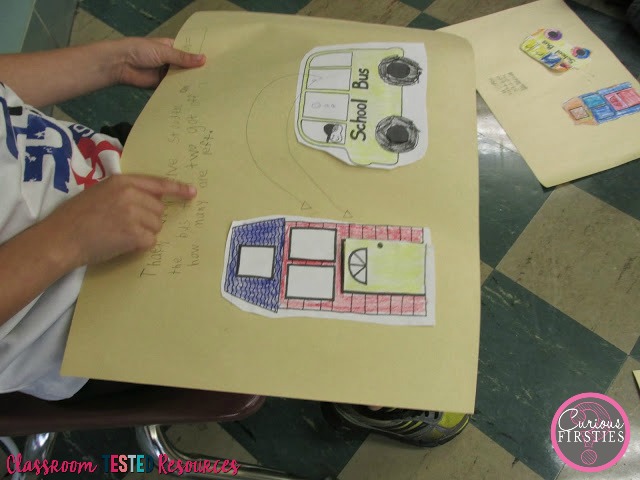
Now when I teach story problems, it is spread out throughout the year into different themes.  Some examples that I have pulled from the resource above: Bus Problems, Cookie Store Problems, Critter Issues, or Teddy Bear Store.  With each new theme introduced, my teammate and I work hard to make it a big deal.  For example, when we begin our Bus Problems, the classroom turns into a bus for the day.  Students decide where we are going.  Then they get on and off the bus.  We add and subtract to solve a variety of issues that a bus driver may have.

What we have found by setting up the "scene" for our new theme, the students get excited!  Instead of dreading story problems...they ASK for them.  They want to know when our next set of them will start!

And just as the quote stated above, because the themes are meaningful to their lives, our students work hard to visualize the story, understand, and solve the problem in a way that make senses to them.

Once the theme is established and excitement is in the air, students work in their guided math groups on problems that all revolve around the theme.  The manipulatives that are available reflect the theme, as well.  For example, for our bus problems, students use lima beans with faces and a bus template.  For our gift giving problems, we have painted cubes and wrapped parcels available.  For the bear store problems, we provide bears with a store and delivery truck template.


Putting stories into my story problem instruction has really changed me and my attitude.  The learning is no longer disjointed, but meaningful and memorable.  My attitude has caused a shift in the way my students approach story problems, as well.  They actually like them :)


What about you?  Do you already use story problem themes in your teaching?  What excites you about problem solving?


Read More...

Finding a Place for Graphic Novels

09 November 2015 / Leave a Comment
Sometimes one of our greatest challenges as educators is to find the thing that "hooks" that student in.  For some of my first graders their love for reading is discovered during our Mo Willems unit.  For others it is when they see the real photographs of a shark mouth in a National Geographic for Kids.  The love is unlocked for some in their homes, while others just cannot seem to find a type of book that "sells" them on reading.

My classroom library grew as I learned about the interests of my students.  Fancy Nancy, Ladybug Girl, sports books, car books, tornadoes/hurricane/weather books, joke books, cookbooks....the list goes on.  I thought that I was hitting the variety of genres available.

Then my daughter came along.  She seemed to be born with the love of all books.  It didn't seem to matter what I put in front of her, she would analyze it, love it, read it again and again.  But as she grew (currently a first grader), she found her true love: graphic novels and comics.


This discovery opened my eyes to what I was not providing to my students.

When I started to dig deeper into this genre, there is a variety of texts out there that appeal to our young learners.  My school purchased graphic novels for our leveled reading library.  Each book begins with a page that explains how to read a graphic novel.  My guided reading groups LOVE  them.  They are always asking for more!


If you are interested in adding more graphic novels into your library, there are several different places that I have found for this need.

My First Graphic Novels: These are leveled readers set up as graphic novels.
Capstone: They provide leveled super hero comics and graphic novels.
Papercutz: This site has an AMAZING collection of comics for Disney characters, Lego series, and other high interest topics.
Balloon Toons:  These are simple comics for young readers.

Is this a type of text that you think your students would enjoy?


Read More...

Technology Tip: Free Epic App

09 September 2015 / 5 comments
For the past couple of years we have been using Raz Kids as one reading component in our classroom.  The kids really enjoy it because it is on the iPad and we like it because the stories are leveled and progress as the students complete a library set.

But this is only one small component of the week.

This year we are adding to the technology component within our reading block with EPIC! (and don't worry, the kids are still spending almost ALL of their time with real books). We introduced the app this week and the excitement in the room was contagious.


EPIC! is a website and an app that offers its services FREE to educators and paid subscriptions to parents.  It is filled with thousands of high-interest stories, some that are read aloud and some that are not.  It is simple and easy to use, yet highly engaging and motivating to our little readers.

Here is how it works.  As the teacher, you set up a profile for each student in your class by typing in their name.  Then your students makes some choices on their interests and the app/website creates a personal library for them.  As the students read from this library, they earn badges and little images to change their profile avatar.

There are few things that I really like about this service that sets it apart from other apps/websites that I have seen.

EPIC! claims to have high interest books for students and it is actually true!  The nonfiction books are filled with really vibrant pictures, labels, and diagrams.  There was such a buzz in the room.  Everyone was trying to show each other the photos that they were looking at in their books.  I looked at the open mouth of a shark, volcanoes erupting, monster trucks, and lots of baby animals.  And that was only the nonfiction.
Some of the fiction titles include Squaredy Squirrel, Bear in Underwear, Charlie Brown, and Berenstain Bears.  Some of our firsties were telling the story by reading the pictures, while others were able to listen to the story being read aloud.  But all were eager to tell us what they had read!

As I mentioned earlier, Raz Kids is based on the student's reading level.  EPIC! is based on the child's age and interest.  And this is what gets them excited!  As they log for the first time, they must tell their age.  Then they pick some topics that they are interested in reading about, such as: adventure, fantasy, sports, humor, etc.  The next screen breaks those choices down into even smaller categories.  For example, if they pick sports as a broad topic of interest, the next screen allows them to decide if they want to read about basketball, hockey, dancing, etc.  WOW!  What an amazing feature.  Each child gets their own personal library!

The reward system for this app/website is very simple and not time consuming.  I saw the students check out the badges that they had earned and they played around with their avatar a bit, but the books were so exciting and engaging to them that they came right back to the reading...quickly!  There are some sites that have such engaging reward systems that the kids don't want to get back to the real task at hand.

And finally, the teacher component.  We always want to ensure that our students are, indeed, staying on task.  EPIC! keeps track of all the activity and reading done by each student.  Teachers and students can see all the books that have been read, the number of finished books, hours spent reading, and number of pages flipped.  (And yes, the app will tell a child if they did not really read a book but just flipped through it quickly).

This is my daughter's profile page.  She can scroll through all the books that she has previously read.  This is also where she can check out the badges that she has earned.


This is what the teacher sees about my daughter's activity.  She can see what books Ruby has completed, the amount of time she spent on the book, how many pages she flipped, and which books she opened but decided not to read.  I love, love, love this last piece of information!  It allows me to determine if there are students that are not finding books that interest them enough to keep reading.


As I sat down to write my post for this month, this was not the topic that I had in mind.  But I just could not ignore the fact that kids were squealing with excitement when I told them that they could use EPIC again today.  My daughter has been getting up at 5 am just to read books from this app before she has to go to school.  The kids could not stop talking about all the cool things they were seeing in the nonfiction images.  And the laughter over the Bear in Underwear stories was music to my ears.

Because of all of this buzz, I had to share.  My hope is that you find the same "loudness" about books in your classroom whether it is through this app, another site, or just the good old books in hand!


Read More...

SCOOTing Into Games

09 August 2015 / Leave a Comment
SCOOTs....
Have you used them in your classroom?  Back in April, I shared a teeny, tiny bit about how I have used them with my students to incorporate more movement in the classroom.

I wanted to dig a little bit deeper.

Through my reading of blogs, professional books, and articles this summer, I feel that there is a continuous reminder of the value....NEED....for engagement.  Whether that is engagement during independent reading, math centers and games, or interactive writing.  Our students must be engaged and motivated during their time with us.

But sometimes...they need some repeated practice, as well.  This is not always very engaging.

I am not a huge fan of worksheets, especially if there is another approach that I can use to hit the skill that I have in mind.  For example, this past year we used a TON of math games to hit math facts instead of math fact sheets.

So...


But let me back up a bit.  If you have never SCOOTed, I wanted to show you how simple and (actually) quick it is.

First, we organize the desks so that the students can move around them easily.  I like to put the desks in a square because my teammate and I can stand in the middle and quickly assess who needs more support.  But any configuration will work as long as students know where to go.

Second, lay the task cards or skill cards on the desks and provide the students with a recording sheet.  (Sometimes I lay manipulatives on the desk as well, if they are needed).  They need to make sure they match the skill card number with the correct answer box.


Then it is time to start.  Students answer the question or problem on the skill card on their answer sheet.  Then when you feel that most students are ready, you say, "SCOOT!"  And they all move to the next desk.  As students answer the questions, I walk around to observe how students are doing. 

Finally, students turn in their sheets.  My teammate and I use their answers to inform our instruction or to form some small groups for intervention.  It has become a great tool for us!

So when could you use SCOOTs in your classroom?

There are so many different ways to use this tool.

Phonics.  Students can get repeated practice filling in the correct vowel pattern and reading the word.  These answer sheets can also be used as sorts when they are finished!


Fluency.  Students can read short passages or poems to each other and decide if it was read fluently.


Math.  There are so many uses for SCOOTs in math: place value, number sense, measurement, fractions, shapes, the list can go on!


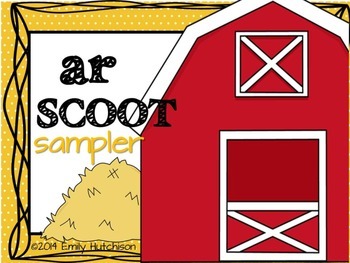
I would love to hear if you have tried these out in your classroom and what your experiences have been!  Were your students engaged?  Were you able to use the information to guide your instruction?  Here is a FREEBIE to try out this year!

https://www.teacherspayteachers.com/Product/Phonics-Scoot-AR-pattern-FREEBIE-1310112

If you are interested in trying out any other SCOOTs this year, here are some that I have available (many are differentiated to meet the variety of needs in your class):

https://www.teacherspayteachers.com/Store/Emily-Hutchison/Category/SCOOTs

Do you have any other games that you use in your classroom to promote engagement?


Read More...

Setting Up Your Planning Binder (Freebies)

09 June 2015 / 5 comments
Last month we asked a question about organization.  We all have our different styles to keep us organized.  One thing that most teachers have is some kind of planner, binder, digital document or folder to help us prepare for our lessons and week.  I think I may have tried just about all of them but I have found (recently) that a planning binder works best for me.


Summer is the time that I clean up my teacher binder for the year.  Actually...I start over.  Completely.

I think this reflection is important because it can be easy for me to over-stuff my binder with great resources and references. ( As I reflect on past posts that I wrote about my teacher binder, I can see this evolution in place.)  But the over-stuffing can cause me to feel overwhelmed and frustrated as the year progresses.

My solution:  Take everything out of the binder and really think about whether or not it was a resource I used or something I accessed in an alternate way. For example...our writing calendar for the year looked so pretty in my binder.  But I actually only used the digital version of it.  While I used my sight word sheets so often that I needed to print a new master copy that was not marked all up.


Once I decide what I need to keep and what I need to remove (or move to a different binder), I think about my goals for the year.
*One of my goals for this upcoming year is to vertically plan lessons; therefore, I want to make sure I have the Common Core standards in my binder but also the vertically alignment documents so that I will be ready to plan the different teams in my building.
*Another goal (as a whole building) is to be more explicit with our vocabulary instruction.  My teammate and I are creating a vocabulary list based on the poems and nursery rhymes we are using for phonological awareness and fluency instruction.  This must be in my binder!
*My third goal is to contain my post-it notes this year.  I typically have them on my binder, on my computer, in my car, anywhere, and everywhere.  I made a sheet in my binder to house these post-its!


After I have analyzed what I need and don't need, determined my goals for this year and what I will need (paper-wise) to reach them, then I can start organizing my binder to help me be as efficient as possible when I sit down to plan each week.
I gather:
*sheet protectors
*a new binder
*2015-2016 calendar
*district calendar
*all printed materials I need


I finished organizing my binder today and it feels good to have a clean start.  And next summer...I'll start all over again :)

If you are interested in any of the materials you see above, just click on the links below.

2015-2016 Calendar-Free
Wavy Divider Sheets-Free
Striped Divider Sheets-Free
Vertical Math Alignment-Free
Vertical ELA Alignment-Free
Leveled Reader Correlation chart-Free
First Grade Common Core Standards-Free

What do you put in your planning binder?


Read More...
Powered by Blogger.
Back to Top