Showing posts with label ELA. Show all posts

Five Effective Techniques for Teaching Vocabulary

06 March 2019 / 2 comments
If you're looking for teaching ideas to build vocabulary, then check out this post on Classroom Tested Resources. It included five effective techniques for teaching vocabulary.
Can you keep a secret?  You can?  Here it is...

"Looking up vocabulary words in a dictionary to get their meaning is considered THE WORST instructional practice for vocabulary instruction," according to the research studies shared by Nell Duke at the Virginia State Reading Conference. 

Read More...

Character Resources for Reading

17 February 2017 / 1 comment
Resources for teaching characters in reading.
Characters are a huge part of reading. Most of our fiction texts have characters. I would go as far as saying characters are what make reading so much fun.
Read More...

Ideas Old and New for Working With Letters

14 February 2017 / Leave a Comment
Working with letters can be fun and engaging with students. It helps them to learn many of those important literacy skills and be ready to read

Do you have students who are still struggling to learn the letters of the alphabet? Or are you rethinking how you want your students to work with the alphabet next year? Using letters in different ways helps students learn and use the letters of alphabet in meaningful ways.

Read More...

Book Kick-Off

03 November 2016 / Leave a Comment
Are you struggling to keep your students engaged during independent reading time? I tried this Book Kick-Off to introduce my fall collection of books to my students, and it was a big hit!
Read More...

Is Time on Your Side? Solutions for Making the Most of the Time You Have.

06 October 2016 / Leave a Comment
In this post, you'll get tips on how to save time. After all, time is always something we seem short of. Check out these time saving tips to see if any of them will help you out.

If you are struggling to fit it all in, then guess what? You are not alone. I can confidently say that every teacher I know has faced the crunch of time. Time is just not on our side. We run short to get all of the content in, time to remediate skills our students haven't mastered, time to complete grading, and time to complete all of our plans and preps. Therefore, the best we can do is make every minute count.
Read More...

How to Make Your Students into Authors Without Tears or Hair Loss

06 August 2016 / Leave a Comment
Turn your students into authors without tears or hair loss using the Writing Fix mentor text lessons for creative and sound instruction.

Just look at the energized and enthusiastic appearance of this young writer! Kids LOVE sharing their work with others. They love the pride of a finished product showcased for all to see, and they love the positive feedback they receive when someone notices what great work they've put together. We all know that quality writing (like reading, basketball, and art) takes practice, but writing can be LOTS of fun both for teachers and students if you find interesting ways to teach, model, and practice. Today, I'd like to share with you a WONDERFUL WEBSITE called The Writing Fix. You will be so glad you found this post if you aren't familiar with it already. 
Read More...

Vocabulary Teaching Tools and Options That Work

06 June 2016 / Leave a Comment
Vocabulary instruction is key to students understanding complex texts. If you're looking for ways to beef up your vocabulary instruction, then this post is for you. It is filled with teaching tips and links that you can use today, tomorrow, and years to come.
What are your go-to tools for teaching vocabulary? What techniques do you use for building word knowledge in your students? How much time do you dedicate to vocabulary? Do you address vocabulary across the curriculum? Certainly, the answer to these questions may make you feel...
Confident...Vocabulary is my priority.
Confused...No time and how do you make it stick
or something in between
Regardless of where you are with vocabulary, we can all agree that vocabulary is a huge factor in student success, so now what? Well, today, I plan to share with you teaching ideas, tools, and tech ideas you might use to build vibrant vocabulary in your students. 
Read More...

Summer Reading Lists for Grades K through 5

09 May 2016 / 2 comments
Looking for printable book lists for your students? This post shares ideas to help with Summer Slide and includes freebie book lists for all grades.
Are you drowning in paperwork with the school year ending? If you're like me, then in addition to the overwhelming paperwork, you're beginning to get sentimental about the year ending and worry how your kids will do over the summer. Never fear, today's post will ease your mind and your workload. 

Today, I'm going to share with you several options you might find easy enough to implement without loads of stress on any one person and without adding to your to-do list.

Summer Reading Camp

As a reading specialist, one of my biggest worries with struggling readers is summer learning loss, otherwise known as, "Summer Slide".  We know from research that children lose about six week's of instruction when they go through the summer without picking up a book. For years, our leadership team has observed this and tried sending the kids to summer school or sending home books, but for our students, we just did not see the benefit. A few years ago, we heard about another division offering a "Summer Reading Camp", and this idea just meshed with what we felt our kids needed. Then, our school was lucky enough to partner with a local college that needed to offer a summer reading clinic for a small group of graduate students. Ah ha! The perfect match! We had a few staff members willing to come in for a few weeks with the relaxed atmosphere, and what we found is that our kids enjoyed it so much that they could not wait to come each day. Many would have been at home doing nothing, so getting books in their hands, experimenting, working on math, and other literature based activities was not "school" to them, but fun for them. To pay for it, we used Title 1 funding to provide the bus and pay for the personnel that's helped out, and overall, the cost has not kept us from being able to offer it. The other great thing is that it's helped us keep our library open for check out for others too.  For more information on the camp, you can check out [THIS POST] over on Virginia is for Teachers as well as some of the posts I wrote up last summer about the themes we chose.

Online Book Club

This summer, one new idea I am looking forward to trying is an online book club for fourth and fifth graders which I think will be lots of fun too. I am hosting it on a "sister blog" called, "Where Wild Readers Roam" which I had originally designed for classroom blogging. There are several wonderful titles that are being considered for use with the book club, and if you happen to teach in an upper elementary grade level, you might help me with making the best choice. Just click on the image below to put in your vote. I will announce on the blog which three titles I plan to use this summer on May 15th. In my posts, I will share discussion questions, a few project or journaling ideas, as well as other points that tie in with the chapters. All comments will be moderated, so there will be no worries of inappropriate comments going up. 
If you teach fourth or fifth grade and are looking for a way to keep your students reading, check out this post to learn about an online book club for kids hosted by Comprehension Connection on Where Wild Readers Roam.
If I don't choose a book you think your students will enjoy, no problem. Feel free to organize a book club for them with a different choice. :-) Won't this be fun?

Recommended Reading List and Parent Tips

In addition to summer programming, one thing many parents appreciate are summer reading lists. Last summer, I put together lists for second and third grade as part of a blog hop, but I decided to extend the lists to other grades too. This freebie should be quite helpful to classroom teachers even if you decide to make your own list. It may or may not match your students needs, but it at least gives you a starting point and guess what?  It's ready to just print and use!
Looking for printable book lists for your students? This post shares ideas to help with Summer Slide and includes freebie book lists for all grades.
If you prefer a student formed list, you might check out THIS POST about making and using top 20 lists with your students. These lists are perfect for matching readers to the genres they prefer. There is a freebie included with that post to help you with student selected book lists too.

From these lists, I want to highlight a few of my favorites. I am sure you have favorites too, and certainly, I'd love to hear your thoughts in the comments.

Kindergarten:

For kindergarten students, we need to look at books that have controlled vocabulary and limited sentence length. Rhyme and repetition are important, and for that reason, I love Mo Willems. His books have all of these traits, and kids just can not get enough of them. I also love Dr. Seuss for kinders because of the rhyming. This is a must for emergent readers to master, so reviewing this through the summer is important. For those kinders who are reading a little, my go-to books are Biscuit, Puppy Mudge, Tiny, and Mittens books. Kids love animals, so these are great choices to reel them in!

First Grade:

For this grade level, you need to start with the books at or around the first grade level. Most first graders are reading Clifford and Little Critter books at the end, and these characters are so lovable that for summer reading, they are like comfort food. On that same line, but with a little more challenge, Henry and Mudge might work. They are written at a second grade level, and they are no problem for many rising second graders. For fragile students, I also use many of the Green Light Readers (level 1 and 2) and Rookie Readers. Rookie Readers are often nonfiction, and it's important to get variety.

Second Grade:

For most rising third graders, there is a desire to move into chapter books. For kids reading a second grade to third grade level, I love Magic Treehouse and Junie B Jones books for starters. I also can not get enough of Mercy Watson and now, her newer series with Francine Poulet. I think it's the feel of the book pages. Do you love them too? (I am probably just weird about that!) For stronger students going into third grade, you might go with the Weird School Series by Gutman, Horrible Harry by Suzy Kline, and the Boxcar Children by Gertrude Warner. 

Third Grade:

As we move toward upper elementary, we get much deeper with the content. For struggling students, it is very important to not push them into advanced books faster than when they are ready. Certainly, they will prefer books with shorter chapters such as How to Eat Fried Worms or Stone Fox. For my fourth graders, the Captain Awesome series was a hit. They also loved the Heidi Hecklebeck series. Both of these are fairly new. For stronger rising fourth graders, I'd recommend Beverly Cleary, Judy Blume, Andrew Clements, Jeff Kinney, the Big Nate series, the American Girls, and 29 Clues

Fourth Grade:

We are getting into deeper literature with rising fifth graders because much of our content demands it. Certainly, students at this level have reading preferences, so it's important to match their interests. I love the Joey Pigza series, Because of Winn Dixie, Chocolate Touch, From the Mixed up Files of Mrs. Basil E. Frankweiler, and anything by Dick King Smith for this level. This grade level might try books by EB White too.

Fifth Grade:

For rising sixth graders, you might explore Gary Paulsen, the Percy Jackson series, Avi, all of Kate DiCamillo's books, the One and Only Ivan, Wonder, Holes, Esperanza Rising, Bud, Not Buddy, Sharon Creech and Roald Dahl. Wow, there are so many great choices!  

Solutions for Your To-Do List

Well, I may not have all the answers, but I hope that the two freebies at least help you take care of a few things on your list. To download them, simply click the images below. 
    Top 20 Book List
I hope the end of the year goes smoothly for you, and just think, you only have a few more weeks to go til we hit summer! 

Read More...

Keeping Students Engaged in the Text

20 February 2016 / Leave a Comment

At about this time of year, my students got bored.  Bored of the same old, same old.  Tired of the questions. This was always about the right time to toss some novelty in the classroom!

Are you looking for some novel ideas to keep kids engaged while reading?


In first through third grades, students are asked to ask and answer questions in a text.  Of course, the difficulty of the task depends on the grade level, but the core idea is the same. This is something we worked on all year long.  We started by creating an anchor chart with possible words that could start a question.  In years past, I have also created more explicit question stems, it just depended on the class. This anchor chart was up all year and was a great reference and foundation for students.


To keep kids engaged in the text, we tracked questions we created.  Then we checked off if the question was answered in the text.  I also wrote the student's name next to the question to help give ownership of the question.  The kids loved seeing their names on anchor charts!


Another way to keep students engaged in the text is to talk about predictions.  Most students are familiar with predictions.  However, they make them before they read the text and that is that.


You can actually do a lot with predictions to help support metacognition.

I always looked at predictions like questions. We made them before reading, and reflected on them during and after reading.  We would adjust our predictions in the middle of the text and check to see if our original predictions from the beginning of the text were correct.   At the end of the text, we reflected on our previous predictions and then wondered, "What next?"

It really helped keep kids engaged throughout the entire text.


Another novel idea for informational text is a Fact, Question, Response chart.  I used this as a loose organizer for student thinking while reading.  


We were able to write down interesting and IMPORTANT facts while reading the text.  These are great, because later you can reflect on the facts and determine if any of the facts are key details. 

The question column is similar to most questioning activities.  We checked off any of the questions we found answers to.  

The response area is very powerful.  It is a great place to make inferences and  defend thinking with evidence from the text.

You may notice that some of the sentences are highlighted.  After we completed the chart, we highlighted any of the important ideas we wanted to include in a summary of the text (Thank You, Sarah Hale).  Students were surprised that we had collected so many of the important ideas during our thinking!

Looking for more novel ideas while reading? Make sure to check out the Classroom Tested Resources pinterest board.


How do you keep kids engaged in the text while reading?  Any other novel ideas?


 If you would like more ideas, be sure to follow Classroom Tested Resources on Instagram, Pinterest, and Facebook to catch all the freebies and ideas and more!

PIN for LATER:


Read More...

Character Analysis Made Easy!

10 December 2015 / Leave a Comment

As we navigate the fun of the holiday season, I am always working to finish up the last pages of our latest novel unit in order to bring our hard work to a close and start fresh in January upon our return from our winter break. This can be a tricky time, but with "stick-to-it-iveness" and engaging work, we can do ANYTHING! 

One of my favorite beginning and end of novel focuses is character analysis.  As 6th graders, my students are expected to describe how a particular story's or drama's plot unfolds in a series of episodes as well as how the characters respond or change as the plot moves toward a resolution.(RL. 6.3) While this seems like a fairly simple concept, my students can struggle with determining how a character changes based on specific events from the story.  So here is how I help them grasp this concept.

Read More...

One Teaching Technique EVERY Teacher Needs

05 November 2015 / Leave a Comment
Are your kids fluent readers? If the answer is some, then this post is for you. Creating poetry notebooks for repeated reading is a great strategy for improving fluency. Check out this post for more

When you think about your classroom routines and your teaching methods, what three techniques are your go-to options? Maybe it's interactive notebooks, anchor charts, and Daily Five?  or Maybe you love Close Reading, Mentor Texts, and Centers? I'd like to propose that you poetry notebooks into your daily routine.

Read More...

Using Text Details in Poetry to Visualize

15 October 2015 / Leave a Comment
One of the most important skills readers need is visualizing. If kids struggle with visualizing, it makes it very hard to comprehend. There are ways to work on it though. Check out this post for using visualizing with poetry.

One of the most important skills readers need is visualizing. If kids struggle with visualizing, it makes it very hard to comprehend. There are ways to work on it though. Today I'll share a few with you.
Read More...

5 Reasons You Must Make Time for Reading Aloud (And How)

06 September 2015 / 2 comments
Who thinks read alouds should be part of daily instruction? ME! This post explains how read alouds can be used for direction instruction and more. Check it out!
So, readers, I have a task for you.  Grab a piece of paper, and take a moment to brainstorm a list of books you remember from reading as a child.  Now, rank them in your order of preference.  Did you have trouble coming up with a list?  I bet you didn't.  Have you done this with your students?  Do you think they'd quickly jot down names, or do you think some would struggle?  Here's the deal...

Every child should "know" great children's authors.

Sadly, many of our children are missing out on truly "knowing" the greats. We are often pressed for time and if something has to be removed from the schedule, some teachers choose the read aloud time. (Gasp!)  Today, I'm going to share with you ways that you can weave in great literature into your lessons without losing one ..bit...of...time. Ready?  Well, here we go...


Use picture books to model reading skills.   

Many picture books are rich with Tier 2 vocabulary which our students need, and if you're teaching reading skills such as character traits or character development, why not use authentic literature like Strega Nona or Thunder Cake to demonstrate.  Have you read Lilly's Purple Plastic Purse? At the second grade level, it's a hit, but again...filled with meaty vocabulary.  Authentic literature read using Think Aloud shows students how to think as readers when they're reading these books on their own. 

Tie your writing assignments to literature...always.

Have you ever noticed that your strongest readers are typically your strongest writers? Reading and writing go hand-in-hand, and the best way to learn to be a great writer is to read great writing.  When you choose books as your model, remember you do not need to read the full book each time.  Sometimes using just the opening pages to model how to hook your reader is what you may need, or you might select examples of persuasion for when you write a persuasive paper.  (Example-How to Babysit a Grandpa or My Lucky Day.)

Read alouds relax students and help them transition after high energy activities.

After PE or recess, kids need to transition back to the classroom mindset. They may have frustrations from the playground or may be too hyped up to focus. Reading a great book calms the mind. Have students practice making predictions and visualizing as you read.  Pause for discussion after you've read a bit.  Want to add extra interest? Let the group vote on the books you read to them. For this reading experience, chapter books may be preferred, but do not write off picture books. VanAllsburg, Polacco, Rylant, and DePaola are all great options for upper elementary.

Reading aloud to your students models fluency.

Children who hear fluent reading will copy it when they read on their own. When you read aloud to your students, use this time to discuss the five P's of fluency (prosody, punctuation, phrasing, performance, pace). Here is a little freebie you can use with your kids to discuss as you read.  It can be projected or provided to students for their reading notebooks.

Often, students get stuck on one genre. Read alouds can introduce students to new experiences with different genres AND the thinking that goes with each.


Students tend to read primarily fiction, but by using a variety of genres when you are choosing read alouds, you expose your students to new options. One reason this is a must is that students USE primarily nonfiction in their learning.  Additionally, our standards require us to teach students comprehension strategies with folktales, myths, historical fiction, biographies, and more.  You can model text structures with these types of read alouds.

By this point, you are likely thinking of the many other reasons to make time for read alouds, and I hope you can come up with many others.  Yes, selecting what to share takes time, but you can start with exploring Good Reads, Amazon, and Pinterest of course, and by all means, talk to your librarian. I have been lucky to work with two very knowledgeable librarians in my career who knew books, and if they couldn't come up with what I needed, they knew where to look.  That's huge!  

Now, before I sign off, I'll leave you with one other little freebie I've had in my store.  Mrs. Spitzer's Garden is a wonderful teacher book, and with the mini unit I made, I included comprehension skills you can model with the book.  The book units in my store are all set up with a focus on comprehension, and remember, picture books are not limited to primary grades alone. Patricia Polacco, Jan Brett, Mem Fox, and Cynthia Rylant are authors will much to offer students in upper elementary.  

I hope you and your students will enjoy read aloud time all year long. Until next time, happy reading!
Read More...

Planning for Daily Science Integration in Your Classroom

24 July 2015 / 3 comments
science planning primary

Hi All,
This is Sarah Winchell from Science is for Kids. My website is undergoing a big make over with a new logo and a new look. I hope to become your go to site for primary grades science! I will be dipping into upper elementary as the year goes on. I would love for you to visit and keep visiting as my site changes!

I know all teachers are busy and it is a huge job to cover the all the standards and to teach science. I have heard from some teachers that they are being told to not teach science! That is sad...you don't have to give it up. Science, STEM and Engineering in Education are on the rise so please don't leave it out.  One way to make sure kids are getting the science instruction they deserve is to add it into your daily routine during other subjects.

You can practice math skills using rocks and then have a discussion about states of matter. Rocks are certainly a solid!! In the photo above we were ordering the rocks according to size and we used the rocks to sort. These rocks are not special they came from our school grounds. What makes them special is that the kids chose them. I give each child a clear plastic cup with their name on it and we go out and gather rocks!  These rocks might as well be gold to the children! They want to use their rocks and only their rocks...... as you can imagine these poor old rocks get quite the work out as the year goes on. If rocks could sigh these might.

We write about the rocks during non-fiction writing units and most importantly we collaborate during our writing. The kids initially write their ideas. After writing they can move about the room asking for suggestions.....edits from their peers. Then after working with editing pals they refine their writing and then publish the next day. This is a great way to address speaking and listening goals in your classroom. Of course I am up moving around during this time working with anyone that needs an extra boost.

I hope you will be able to find ways to integrate science into your daily routine. I will be here to help as I start my new job as an Elementary Science Specialist. I would love to hear ways you integrate science into your daily routine!

Cheers,
Sarah
Science is for Kids
Read More...

Avoiding the Summer Slide (Great Tips and Ideas)

15 July 2015 / Leave a Comment
Hi Everyone! It's me again, Kathleen, from Not So Wimpy Resources! To say that this summer has kept me extremely busy is an understatement! I decided to pursue my goal of running a reading clinic for beginning and/or struggling readers- so this summer I've been tutoring four days a week. I found it important to work with struggling readers over the summer because the "summer slide" is real! My goal was to help as many students make progress over the summer (each private tutoring session was 90 minutes). I wanted to help them make academic growth during the months that students usually regress. 

The term “summer slide” or “summer slip” is used by many researchers and educators to describe the regression of skills many students may experience during the summer months. Unfortunately, the “summer slide” affects millions of children each year. The really sad part is, if a child already struggles in June, the regression of skills could set them almost twice as far back in September. This means that when school starts, they are not only playing catch-up, they are losing valuable instructional time. Teachers have to spend time reteaching prior skills instead of being able to jump right into the current curriculum. 

Sitting idle for 2-3 months or, encouraging kids to "take a break" does more harm than good. Does this mean that a child should be stuck behind a book everyday doing tons of work to avoid losing important skills? No....but they should at least be reading for a minimum of 20 minutes everyday! Experts share that students who read during the summer gain reading skills. Those who do not read, consistently slide backward. According to Scholastic, research shows that struggling readers who read at least 6 books will have a better chance of not regressing over the summer months. 

If you are wondering if it is too late to get your child reading before school starts, the answer is no. In fact, now is a great time to start good reading habits that should carry over into the school year. Here are a few things you can do: 
  •  Make sure your child has an active library card. During the school year some students may lose their card. In addition, they may accrue fees due to overdue or lost book fines. Make sure that your child has a “clean bill” and that their borrowing privileges are in tact. Make it a point to visit the library regularly. Some libraries offer summer reading programs for children to participate in. Your local library is a primary summer resource; be sure to take advantage of it! 
  •  Build time into your child’s daily schedule for reading. Just like during the school year, it is important to keep your child on a reading schedule.
  •  Keep a book in a bag! Take advantage of “wait time” (i.e. dentist appointment, long lines, etc.). Also, long car rides, train rides and time on the beach are great opportunities to read.
  • Provide a variety of reading materials for your students/children to choose from.
  • Lead by example. When your child is reading, show them that it something that the family can enjoy. Pick up a book and read along with them, or, get engrossed in one of the books that have been sitting on your reading list.
  • Read to your child. This helps to model fluency, strengthens vocabulary, and helps to improve listening comprehension.

Parents ask me for suggestions all of the time regarding how to get their child reading or about what they can do to keep their child interested in reading. My professional advice is very simple. 
  • #1--TURN OFF THE TV! Set aside a time each evening where the house is quiet and everyone is reading. 
  • #2. Read the same book your child is reading and talk to them about what they read. Not easy recall questions like, "Where did Sharon go after she left school?". Instead, you want to engage your child in a discussion and ask more "think about it" type of questions like, "why do you think Sharon went to the park after school?", "How do you think the events in the story would've been different if Sharon didn't go to the park after school?" Encourage your child to dig deeper, make predictions, ask questions, make inferences, and draw conclusions about the characters and events in the story.  
  • #3. Set a goal. Use a calendar or some kind of reading log to challenge your child to go above and beyond what is expected. Provide an incentive (maybe one that they choose) and hold them accountable for meeting their target. You can do this based on the amount of minutes or the amount of books read all summer. 
  • #4. Help your child choose a book that has cultural or historical relevance and then take a trip to a historical landmark or museum that teaches about this particular topic. Make the story real. Help your child make the text to world connection- you will literally see lightbulbs go off! 
  • #5. Encourage your child to write. By keeping a journal they can highlight what they’ve read and/or their summer adventures, students continue to use important strategies for reading/writing. 
I'm preparing for my family vacation and I have two books packed that aren't professional books! I plan on reading for fun. I haven't read a good book in a long time. In fact I haven't read a really good book since the last time I was on vacation (last year around this time). What are you reading? What books are your kids reading? Feel free to share below! Also, feel free to share any tips or strategies that you've used to help keep your child motivated to read during the summer months. 

I hope you found this post helpful, 

Read More...

STRATEGIES for High Frequency Words

26 June 2015 / Leave a Comment

Hi There!  It's...


How do you guys practice word work in the classroom?  Do your kids go from week to week forgetting the words from the previous week?  Do they say they are practicing at home, but you can tell that they haven't even looked at their words since you introduced them?  Well, these were some of the issues we were having until we decided to incorporate our words throughout our day for an entire week.  I KNOW - yes, I should have known to do that, but we have honestly never been trained on how to get children to LEARN high frequency words.  We went over the words, practiced the words with flashcards throughout the day, BUT that wasn't enough.  My strong kiddos were fine, but my struggling students had a really hard time keeping these words in their heads.

So, two years ago, my first grade team decided to make our own curriculum with words that we felt students needed to know.  We used both Fry and Dolch words, and put together some of the things we felt would help them retain the words.


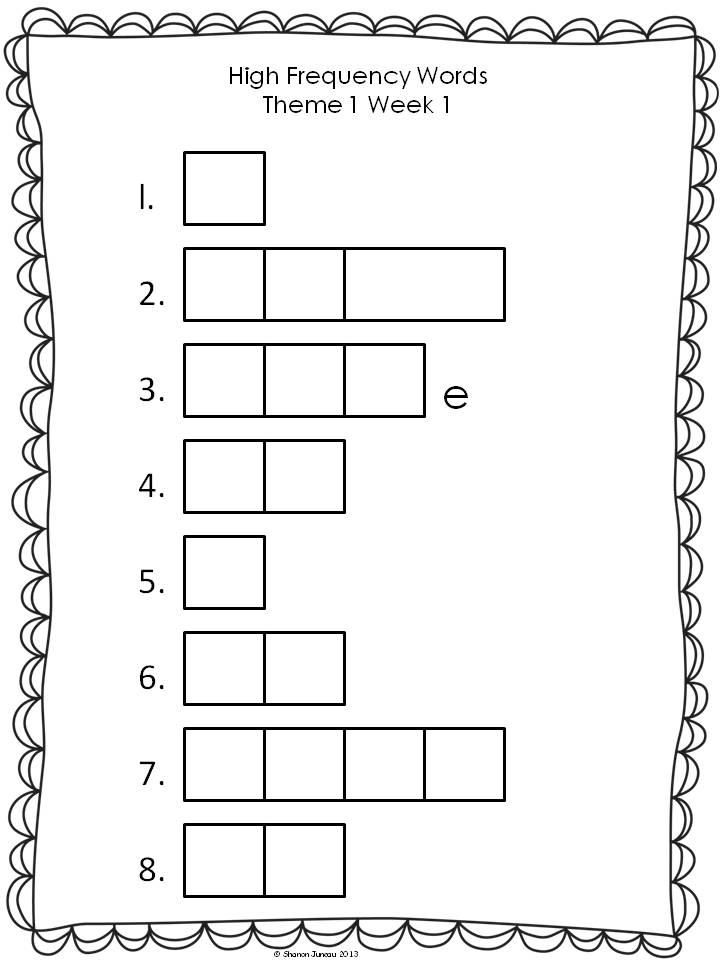
We introduce the words using Elkonin boxes and a baseball game.  The students have their Elkonin box sheet in front of them, and we play Baseball with the words.  The ppt walks you through the game.  The kids chatter, "Hey Batter, Batter..." and then instead of saying SWING, you (the teacher) say the word.  Once you say the word, you ask the students how many sounds they hear.  Then the boxes appear to show how many sounds, and then the word appears per sound.  Once you talk about the word, then the students write their word in the boxes.  I usually have two students say a sentence with the word as they are writing it in their box.  We do this for each word that we have for the week.  

We also have a ppt that we use throughout the day that reviews the words.  Students need to say these words within 3 seconds by the end of the week, so we use our ppt daily for practice.  Sometimes we call each table up to say a word before we can get water, other times it's just a 2-minute filler before we transition to another task.  The powerpoint stays at the bottom of my screen for easy access.


We also have two sheets that we place in the students' binders.  These go home on Monday, and students practice the words and sentences nightly as part of their homework.  Now, some do, and some don't.  We include these sheets so that if a student is having trouble, we can refer to these during conferences. 

Here's one place where students get daily work with our words.   


  • FILL IN THE BLANK: We have pages that have the sentences that students need to practice with the word missing from the sentence.  We have these sheets as fill in the blank with two words to choose from, or fill in the blank where they have a word box to choose from.  We usually start off with most of the class having two words, but gradually move to word boxes.
  • ADD AND SUBTRACT LETTERS:  We have pages where students need to either add letters to make a new word, subtract letters to make a new word, or substitute letters to make a new word.
  • ABC ORDER:  We start off with only words with different first letters, and eventually move to second and third letter order.
  • MIX IT UP:  For our mix it up pages, students have to unscramble the words and then add them up. (The tiles are scrabble tiles, so they add up the points.)  We have another one where they just have to unscramble using the word box.
  • WORD SEARCH:  We also have word searches for the words (a favorite of the kids).  There are different levels of the word search.  I let the kids pick which one they want.
  • CUT AND PASTE:  We have sheets where students have to cut out the words and then glue the words into the boxes to make one of our sentences that match our homework binder work.


Another thing I found useful was making flashcards for students to grab anytime they have down time. We also grabbed these during centers to work with a partner.  One person is the teacher and the other the student.  The teacher has the timer, and the student tries to say the words as fast as they can.  Students actually liked this center.  I guess anytime you give them the role of teacher, they want to play.


We added this one at the beginning of this year, and WOWZA, they loved it!  I used these during guided reading, but students were also able to play BE THE TEACHER with these as well.  The object was to say each sentence correctly, and go through the sentences within a minute.  Not an easy task to do, but once they realized that they had these sentences in their binder as well (and they could practice), they ROCKED it!!  Competition is such a huge motivator.  I had one student who was really struggling with these, and one day during RTI he met his goal!  I overheard this conversation:


Student A: "Guess what I found out?"
Student B: "What"
Student A:  "These are the same sentences that are in my binder."
Student B:  "Really?"
Student A:  "Yep, I'm going to tell Mrs. Juneau so she can tell the class!"

HAHA!!! 

Anyway, these really did help with our fluency (On Dibels as well!)  


OK - so this little center is one of my favorites.  We were told years ago to have students write sentences and then cut them up and then put them back together.  I loved that idea, but truth be told, it's not something I could get to on a daily basis in GR.  This year, they cut our guided reading time, so this center really came in handy.  

This one takes a little bit of prep, but it is so worth it.  I bought white envelopes (the smaller ones) and then taped the sentence sheet on top and laminated.  All the cards go into this envelope.  

  • Buy envelopes to put word cards in (I bought the white ones - small)
  • Tape the sheet with all of the sentences and laminate
  • Students work in pairs (we have two per week and the borders are different so if they get mixed up, students know which envelope the word cards go in)  Meaning, one group works with the curly border and the other group works with the square border.  They race each other.
  • For each group, one student reads the first sentence while the other student builds the sentence with the cut-up words
  • Then they switch roles.
BUT...  it usually becomes pretty competitive since they are racing the other group, so usually they are both building the sentences and both reading the sentences.  It's really cute to see how well they can SYNERGIZE!


I also have included word wall cards that have all the words for the week.  I have a few different colors and either chevron or polka dot background to pick from.  I started off using these this year, but ended up changing my word wall completely.  This worked for me last year, but for some reason I just couldn't get it together this year.  Two of my co-workers did use this system, though, and loved it.


We also have cards in a center that have all of the words for the month.  With these cards, students get the timer and time themselves saying the words.  Students also have a booklet that they keep in their GR bag to track their score in words per minute (this can be done at home)  If you do these at school, you will need a stopwatch.  We didn't actually do these this year, because my students really retained the words, but last year I had a few that needed this extra practice.  


We are a Leader in Me school, so we also needed something for the students to track themselves.  We use our Words to Know Data Graph for this.  On Fridays, I call students up one at a time and they have to say the words within three seconds.  If they miss a word or struggle with a word, I circle it in pencil.  They color all the words not circled.  They know they will have to practice a bit more, and the next week we try again.  We use these graphs for our student-led conferences as well.  The students can explain it beautifully!


All of the above items are included in the weekly product.


Here are some other items that we use in our classroom that I know have helped tremendously with building a foundation of word recognition.  These games still use all the same words, but it's a month of words, rather than weekly words.  So, once you have a month of words under your belt, then you introduce the first set of games.  


My students have created their own version of this game, and since this is our second year doing it, and both classes did exactly the same thing, I'm guessing other classes are doing this as well.  They like to play in groups (usually 2-4 students).  They "divy" up the cards evenly, then turn all the cards face up.  One person starts the game, and then whoever has the next word, says it.  Once you say that card, you turn it over.  If you can get through the entire game, turning over the cards as you go, you win.  But sometimes they get to a card that says who has (word) and no-one has it.  Then they have to turn all the cards back over, look for that card, and start again.  Someone obviously said the wrong word, so they have to start over.  Once they realize that they can't just say words, or the game doesn't work, they pay much better attention to what they are reading.


We also have a board game that practices our sentences.  Each card has a fill the blank sentence (same as the homework and fluency sentences).  Students have to pick the word that fits into the sentence.  (multiple choice).  There is an answer key for this one, so students say, "#7 is A (some say the word), and another student checks to make sure.  Once the student gets the right answer, they spin and move around the board.


OK - so here's a FAVORITE!!  This is an adaptation of the Spot it games, but this one has words, and it happens to be the same words that they have been practicing throughout the weeks.  Once you have taught four weeks of words, you then introduce the new game.  With this game, students put the stack of cards in the middle and each student takes one card.  They then try to find their one match with the center card.  Whoever says their match first, gets both cards, and then picks another card from the middle and starts again.  I make my students prove it, though.  When they say the word, they also have to point to the match.  I had one little man last year who would just say words and always win.  One day I observed him, and was amazed at how fast he was.  Yep, I'm clueless!  But the more I watched, the more I questioned how he could be THAT fast.  I soon found out he was CHEATING! Grrrrr!!!  Anyway, now we PROVE IT!!

**Side note:  I brought these games home this summer, and one day after dinner decided to pull out with my family.  My son and his wife, and my 18 year-old son played these games for over thirty minutes.  These are truly addictive!!  

**Another side note: Once I realized just how much these were helping with word recognition, I made other games that didn't correlate to our High Frequency Word Work so I could have more games available throughout the year.  (ALL SPOT THAT WORD GAMES)  (SAMPLE)

I hope that this helps others as much as it has helped us the past two years.  We've found different ways to use all of the products, and if you end up using, I would love to hear how it works in your classroom.  

ENJOY!


Read More...
Powered by Blogger.
Back to Top