Many studies suggest that reading comprehension may suffer when students read on digital devices that are dramatically making their way into the classroom. Yet, teachers are still expected to integrate technology into their lessons. Teaching comprehension with the good ol' paper book is a challenge in itself. Therefore, how are we supposed to support such a vital reading component when technology is involved?
Read More...
Showing posts with label comprehension. Show all posts
Quick and Easy Comprehension Check
We've all been there, you know when you've designed a perfect unit, created engaging lesson plans, taught your heart out, and yet you still feel like your students just don't quite get it. It happens to even the best of teachers. Try this idea to find out what they are missing!
Read More...
Building Comprehension With Prediction Strategies
25 September 2016
/
Burke's Special Kids,
comprehension,
prediction strategies,
Reading,
think pair share
/
Leave a Comment
Studies on good readers have proven that prediction strategies are one way to deepen reading comprehension. Prediction strategies can be used before and during reading to increase understanding text.
Demonstrate understanding of concepts using visual representations
The process of photosynthesis can be a tricky concept for students to understand. Teachers can help students remember the important steps by having them create scientific drawings. By developing their own visual representations, students are able to demonstrate their understanding of a complex idea.
Read More...
Can competition lead to increased comprehension?
01 September 2016
/
Close Reading,
comprehension,
games,
Reading,
Teacher Treasure Hunter
/
1 comment
Can competition lead to increased comprehension? This seems like a bad combo. We've nearly eliminated competitiveness in some schools -- sometimes to ridiculous extremes. However, we usually try to avoid it in class. We don't want one student to be the best at something -- all students can succeed. So, why would I have this idea and what successes have I experienced that prompted me to explore this idea?
80's Childhood and Reading Machines
I have to briefly go back to my childhood in the 80s first. I was a voracious reader as soon as I started reading. I was one of those kids who had a book for every car trip and tried to read in the dark (you know, wait for each street light so you can read a few more words). My school had a reading tool that they used. I have searched for the actual item on the internet and haven't found it. If you know what it is, please let me know! We called it a reading machine. You had a reading passage that you would feed into the top of the machine. It would roll around a large cylinder and only show you a line at a time. It would continuously advance based upon the reading rate for which it was set. Once you finished "reading" the passage you would take a comprehension quiz. If you passed the quiz (I can't remember if you needed 100% or some other passing grade) you would advance on to the next speed. Now, I am not recommending this method and haven't thought about it in a while. I wouldn't say I was reading for enjoyment at all, but I did learn to skim passages quickly which is a great skills for more advanced courses. I loved it. I loved challenging myself to advance to the next level. It was like a game. A game for good readers. I'll share a few tips below for individual competitions.Scholastic News for Close Reading
Fast forward to last year in my 3rd grade classroom. We use Scholastic News and last year we really enjoyed all the benefits of using the additional resources in the electronic version. The students loved voting on issues and seeing if their results matched the results of kids around the world. The other thing that was a huge hit were the quizzes. I didn't start out doing them all the time and then the kids kept asking for them. I was completely sold on this version of quizzing when I saw some close reading taking place. The game board has different point rewards for each category. The least complex questions would gain the fewest points, etc. I would divide the class into teams. The team (either a team representative or someone I chose) would choose the category. I would display the question and the team would decide on an answer. If they didn't immediately know the answer, the whole group would grab their Scholastic News and start searching and reading everything again carefully! That's what we are always hoping they will do!Valuable Competition
I think some competition can be valuable. You can compete against others or top your own records.
For individual competition, my students enjoy a reading board that has bead chain necklaces. They get a bead for each 100 minutes that they read. They get a special bead or charm for each 500 minutes that they read. Some of my students have been very motivated to read as they see others start to fill their necklace.
Team competitions can be a quiz like the ones I mentioned or a variety of learning games. Make sure the teams are fair and change players at times. Be mindful of any team winning all the time. Then you would want to switch things up and make it more equitable.
In my classroom, adding the element of competition has also shown increased engagement, an opportunity to practice teamwork, purposeful answers (to make sure they get the points) and reading things more carefully.
Powerpoint Classroom Quiz
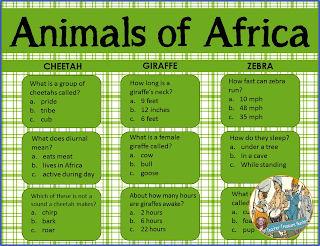
1. Create a quiz using this powerpoint template (or use the included African Animals quiz and research pages). Just click on the picture above to download this quiz and 3 African animal research papers. Click here to get a powerpoint with the blank game board. Just add your own text boxes.
2. Everyone reads the passage silently (chapter, multiple passages, etc.). Tell them there will be a game with questions from the passage so they need to read carefully.
3. Divide the class into teams (2-4 teams). Choose a team to start.
4. Show the board. The 1st team chooses a category and point value. They can look back to find the answer. Designate someone as an official team spokesperson (someone who will listen to others). Ask, is that your final answer to make sure the team agrees. If they miss it, you can tell the answer and/or show where it is in the passage. The team only gets points for the correct answer.
5. The team with the most points wins!
Using DLTA This Summer and Beyond!
How do you get students involved in your read alouds? A simple solution comes out in the DLTA (Directed Listening and Thinking Activity). Students remain involved as you read aloud and gain important comprehension strategies all at the same time! I use it with my own children over the summer as we read and then all throughout the school year as needed.
"Reading" Trash
One of my favorite professional books is Tanny McGregor's Comprehension Connections because she opened up my eyes and made me think outside the box on how to make lessons more concrete. And our struggling students, young students....well...ANY learner (young and old) can benefit from a more concrete/real lesson.
So we did just that this past week. Our first graders received their first "formal" lesson on making an inference when reading. But we did not start with books. We wanted them to realize that inferring takes place all the time and that they have actually been doing since...really...forever; therefore we brought in trash.
Actually, we started the week off with old shoes. My teammate and I explained that we can infer a lot about a person by their shoes. Tanny McGregor encourages students to use thinking stems as they share their inferences about the objects being discussed. We did the same.
After listening to the students "turn and talk" about a football cleat, we shared with them all the great thinking stems they were already using and encouraged them to use a few others (such as "perhaps" and "I can infer").
Throughout the week we brought in a slipper and a child's shoe. Our first graders shared what they inferred about the people who owned the shoes by using their schema and providing evidence from the shoe.
And what they found is that they knew a lot about these individuals even though they had never met them before. Here are some of my favorite examples:
Read More...
So we did just that this past week. Our first graders received their first "formal" lesson on making an inference when reading. But we did not start with books. We wanted them to realize that inferring takes place all the time and that they have actually been doing since...really...forever; therefore we brought in trash.
Actually, we started the week off with old shoes. My teammate and I explained that we can infer a lot about a person by their shoes. Tanny McGregor encourages students to use thinking stems as they share their inferences about the objects being discussed. We did the same.
After listening to the students "turn and talk" about a football cleat, we shared with them all the great thinking stems they were already using and encouraged them to use a few others (such as "perhaps" and "I can infer").
Throughout the week we brought in a slipper and a child's shoe. Our first graders shared what they inferred about the people who owned the shoes by using their schema and providing evidence from the shoe.
And what they found is that they knew a lot about these individuals even though they had never met them before. Here are some of my favorite examples:
Perhaps the shoe belongs to a girl because it is red with heels and I know boys don't normally where these shoes.
The girl probably wore this shoe a lot because the sparkles are coming off.
I think the slipper belongs to a man because it is falling apart and I know a woman would just throw that away.
(HA!! That cracked me up!)
The slipper could belong to a person with a dog because I see bite marks on the shoe.
We explained that when you infer you are "reading between the lines" because you must use evidence that is there but fill in unknown information with your schema. After so many shoe inferences, our first graders were ready to "read" or infer about some trash.
I told them that I have new neighbors (true) and that I don't know anything about them (very true). So I took their trash to find out some things about them (NOT true at all...gross!!)
This was not as simple at first. Some students wanted to infer just based on one single object. We encouraged them to look at the items collectively, to move the objects around, and to think about how the objects relate to each other. When we looked at the evidence in this way, we could make inferences about my new neighbors.
What they discovered was that these people may have had a birthday party because there was a candle, gift bag, and birthday cake yogurt. The neighbors most likely love chocolate due to the 6 candy wrappers. Someone in this house may have been sick since there was a medicine bottle, tissues, and a tissue box.
Throughout these conversations, we recorded the inferences and evidence (and schema) on a chart paper to help them understand that they were not just making predictions but backing up their ideas with evidence!
After all the learning that occurred throughout the week, we really wanted to see what they would infer on their own. We asked them what they could infer about the owner of this trash can:
If you would like to try this quick sheet out, just click on the image to grab it.
Throughout the week we used books to practice inferring, as well. Some wordless books by Lita Judge were used and some alphabet books. If you would like to read more about these individual lessons, please click on the words in the previous sentence.
Do you have any other concrete lessons that you use to help your students infer? I would love to add them into our first grade plans!
Powered by Blogger.